 I have terribly slacked at the Historical Food Fortnightly. I had the best intentions, and plans lined up, ... and life happened. I might try to catch up some because I have recipes I want to try out. For the current challenge, I did something relatively safe because it's my son's birthday and I wasn't sure he'd like the other option I was considering (which I might still test out someday).
J'ai été très nulle pour suivre le Historical Food Fortnighly. Pourtant j'avais des plans et tout et puis... oups, comment ça, l'été est fini ? Enfin bon, je reprends le train en marche ! Quelque chose qui ne me semblait pas trop étrange ou risqué parce que quand même, c'est l'anniversaire de Grand Troll, et je voudrais que Grand Troll aime son gâteau. Je testerai peut-être l'option chelou une autre fois...
The Challenge: Let them eat cake !
Le Challenge : Qu'ils mangent du gâteau !
(bon, techniquement, "let them it cake !" est une traduction de "ils n'ont qu'à manger de la brioche", ça tombe bien, j'ai fait un gâteau à pâte levée !)
(bon, techniquement, "let them it cake !" est une traduction de "ils n'ont qu'à manger de la brioche", ça tombe bien, j'ai fait un gâteau à pâte levée !)
The Recipe: from La Mode Illustrée, May 22th, 1898
This one amused me. From the name and the recipe itself, I assume it's some sort of hear-say gugelhupf. The recipes you find on the web are really similar.
My late 19th century fashion magazines contain a lot of recipes, sometimes (like here) including a mention that a reader sent them to the journal. This recipe was sent from the Doubs, not far from Alsace (in 1898 part of the German empire) and the the southern german-speaking areas, where this cake originates from and is a traditional treat. Apparently the recipe travelled a little further to the other side of the border and the name was transcribed with some alterations. Actually, one place in the magazine spells it Gonglof, and the other Ganglof.
La Recette : La Mode Illustrée, 22 mai 1898
Le concept m'a amusée, visiblement c'est un Kouglof voyageur qui est passé d'une région germanophone jusque dans le Doubs, avec quelques menues mutations orthographiques (le sommaire écrit ça Ganglof !). En tout cas, la recette est similaire, les ingrédients aussi, et le moule à kouglof est souvent en terre cuite (tiens, ça y est, j'ai envie d'un moule à kouglof en terre cuite maintenant !). Les magazines fin XIXème avec lesquels je bosse sont pleins de recettes souvent comme celle-ci envoyées par des abonnées. Le blog cuisine version 1898.
GonglofFaites fondre 125 grammes de beurre frais dans un demi-litre de lait tiède, délayez-y 25 grammes de levure de bière, ajoutez 4 oeufs, 200 grammes de sucre, 2 cuillerées d'eau-de-vie et 2 livres de farine. La pâte doit être travaillée fortement jusqu'à ce qu'elle boucle bien.
Ajoutez-y 200 grammes de beaux raisins secs et faites lever pendant deux heures dans un moule en terre cuite que vous aurez frotté de saindoux froid et garni d'amandes pelées.Faites cuire au four proportion pour 12 personnes.
Si la levure est bonne ces deux gâteaux réussiront toujours.
Merci à notre abonnée du Doubs
Let 125g of very fresh butter melt in half a liter luke-warm milk, mix 25g of beer yeast in it, add 4 eggs, 200g sugar, 2 spoonfuls of brandy and 2 pounds of flour. Work the dough until it "curls" well.Add 200ggood raisins and let rise for two hours in and enameled cake mold that you will have previously rubbed with cold lard and garnished with peeled almonds.
Bake in the oven, serves 12.
As long as the yeast is good, these two cakes will always be a success.Thanks to our reader from the Doubs.
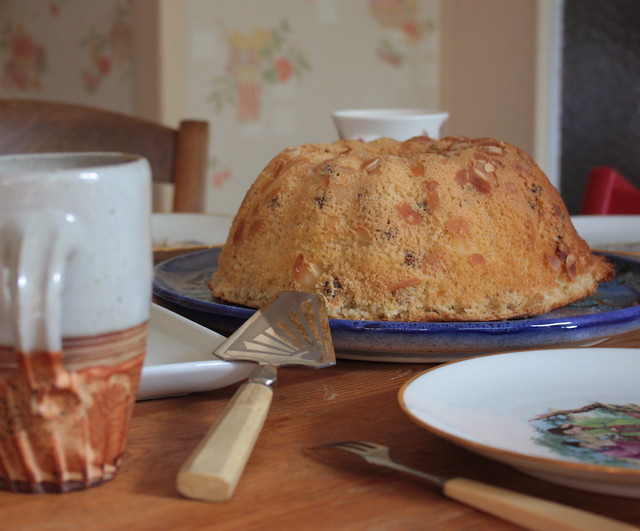
I adapted a bit, substituting vegetal butter for real butter and oat milk for milk, because lactose is not my friend. I had some beer yeast... or so I thought. It clearly wasn't "good" anymore - I tried starting it with a small portion of oat milk and sugar before just to check and got zilch. So I used what I had at hand, dehydrated bread yeast. As for brandy, I used vanilla-flavored rum, as it was at hand, contrary to cherry which would probably have been better for a gugelhupf (altough on the subject, the recipe leaves it up to the cook to choose which brandy to use).
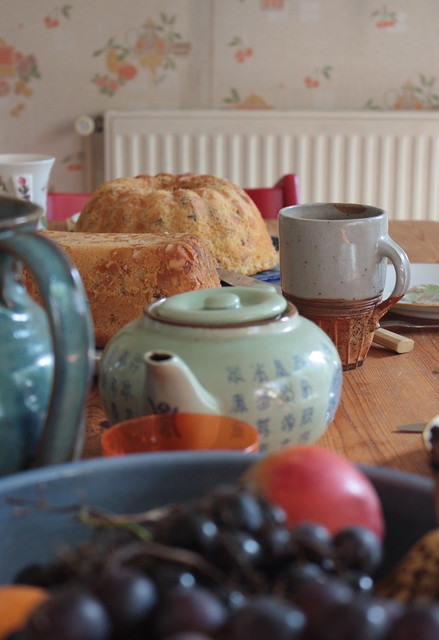
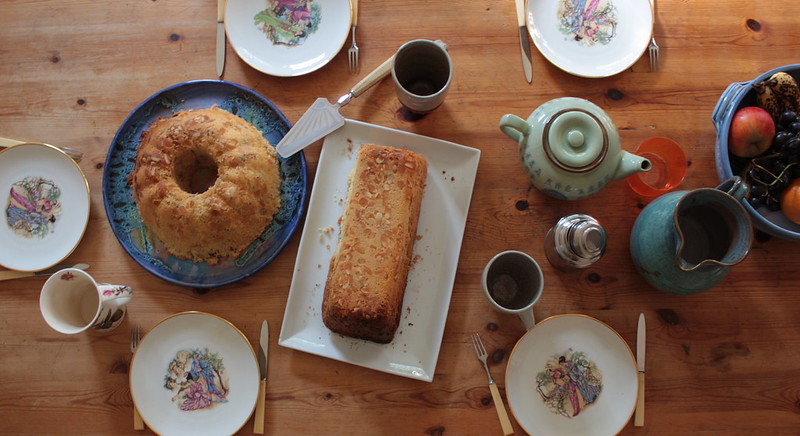
And then, I made the thing... and I got too much dough. Twice too much I thought, so I put it in two separate molds - one tin mold in the traditional gugelhupf form and a regular rectangular oven-proof glass mold, as I don't have the prescribed pottery mold. I let the dough rise for two hours... and it went over ! So please note : the original proportions are for way more than we would usually bake for. In my transcription, and for my own notice next time I make it, I divided the quantities by two !
As for the kitchen utensils themselves, I used my kitchen robot wonder to knead the dough, and a modern oven to let it rise and bake it.
And then, I made the thing... and I got too much dough. Twice too much I thought, so I put it in two separate molds - one tin mold in the traditional gugelhupf form and a regular rectangular oven-proof glass mold, as I don't have the prescribed pottery mold. I let the dough rise for two hours... and it went over ! So please note : the original proportions are for way more than we would usually bake for. In my transcription, and for my own notice next time I make it, I divided the quantities by two !
As for the kitchen utensils themselves, I used my kitchen robot wonder to knead the dough, and a modern oven to let it rise and bake it.
Réalisation :
Il y a eu déjà les adaptations de base, St Hubert pour le beurre et lait d'avoine pour le lait. Pour la levure de bière, je pensais en avoir... sauf qu'elle était périmée depuis des années (j'ai quand même essayé de la faire démarrer avec un peu de lait d'avoine tiède et de sucre... que dalle), donc je me suis rabattue sur la levure de boulangerie déshydratée.
En guise d'eau-de-vie du rhum à la vanille et plutôt que des amandes pelées des amandes effilées. On fait avec ce qu'il y a dans les placards. Du St Hubert aussi pour beurrer le moule plutôt que du saindoux.
Et... ça fait beaucoup, beaucoup, BEAUCOUP trop de pâte ! J'ai rempli mon moule à kouglof (en métal, je n'en ai pas encore en terre cuite), j'ai rempli un moule à cake en pyrex... et au bout de deux heures de levée j'avais un troisième gâteau dans la lèche-frite ! Dont acte : pour la recette adaptée, j'ai divisé les proportions par deux.
La pâte a été pétrie dans mon robot moderne chéri d'amour, et levée et cuite dans mon four tout neuf tout aussi chéri d'amour.
Il y a eu déjà les adaptations de base, St Hubert pour le beurre et lait d'avoine pour le lait. Pour la levure de bière, je pensais en avoir... sauf qu'elle était périmée depuis des années (j'ai quand même essayé de la faire démarrer avec un peu de lait d'avoine tiède et de sucre... que dalle), donc je me suis rabattue sur la levure de boulangerie déshydratée.
En guise d'eau-de-vie du rhum à la vanille et plutôt que des amandes pelées des amandes effilées. On fait avec ce qu'il y a dans les placards. Du St Hubert aussi pour beurrer le moule plutôt que du saindoux.
Et... ça fait beaucoup, beaucoup, BEAUCOUP trop de pâte ! J'ai rempli mon moule à kouglof (en métal, je n'en ai pas encore en terre cuite), j'ai rempli un moule à cake en pyrex... et au bout de deux heures de levée j'avais un troisième gâteau dans la lèche-frite ! Dont acte : pour la recette adaptée, j'ai divisé les proportions par deux.
La pâte a été pétrie dans mon robot moderne chéri d'amour, et levée et cuite dans mon four tout neuf tout aussi chéri d'amour.
Time to Complete:
It was made very quickly, about 15 minutes tops for the preparation, then 2 hour of rising and about one hour baking in the oven.
It was made very quickly, about 15 minutes tops for the preparation, then 2 hour of rising and about one hour baking in the oven.
Temps de préparation :
A peine une petit quart d'heure pour faire la pâte, 2 heures à lever et à peu près une heure dans le four.
The Result :
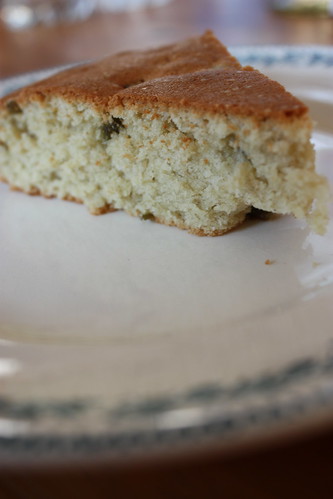
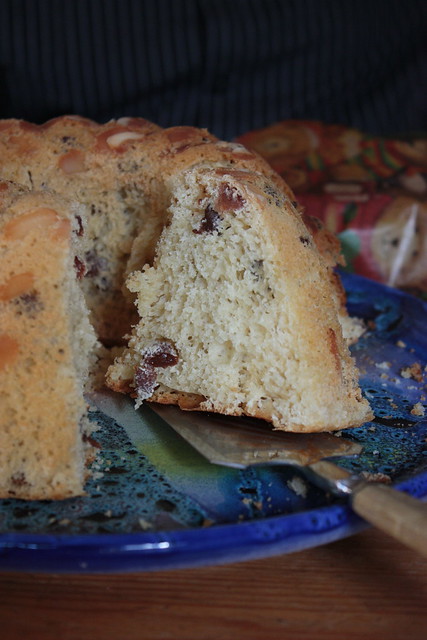
While there was a lot of cake, it was surprisingly light and airy, and I only ended up freezing three slices, the rest was all eaten up ! The general consensus was "Yummy, keep the recipe !" and I am definitely adding this one to the recipes I will make regularly. The cake is excellent fresh, and I suspect it will be very good with a ltitle of bit of butter spread on it for breakfast.
It does however get a little dry, which is why I froze the three slices after a day. Time will tell how it reheats.
Le résultat :
Excellent ! Certes, ça fait beaucoup de gâteau, mais il est tellement léger qu'il a été mangé très, très vite. La seule raison pour laquelle j'ai congelé trois pauvres tranches, c'est qu'il a un peu tendance à sécher.
On a mangé du gonglof à goûter, du gonglof en dessert, et du gonglof au petit-déjeuner. On n'a pas testé la tartine de gonglof beurré encore, mais je pense que ça viendra.
Transcription
65g de beurre - 2,25 oz butter
1/4l de lait - 1/4 litre milk
1/2 sachet de levure boulangère déshydratée - 1/2 bag active dry yeast
2 œufs - 2 eggs
100g de sucre - 3,5 oz sugar
1 cs de rhum - 1 tbsp rum
425g de farine - 16,8 oz flour
100g de raisins secs - 3,5oz raisins
amandes effilées - slivered almonds
Faire fondre le beurre dans le lait tiède, ajouter et délayer la levure, puis les œufs entiers, le sucre, le rhum et la farine. Pétrir au robot jusqu'à obtenir une pâte bien lisse. Ajouter les raisins secs et pétrir encore un bon coup.
Beurrer un moule et y saupoudrer des amandes effilées. Verser la pâte dans le moule et mettre à lever dans un endroit chaud pendant deux heures, puis au four à 160°C pendant une petite heure.
Melt the butter by placing it into the lukewarm milk, add the yeast and mix it well with the liquid, then add teh whole eggs, sugar, rum and flour. Knead in the breadmaker into a smooth dough. Add the raisins and knead some more.
Grease a cake mould with butter and sprinkle it with slivered almonds. Pour the dough into the mould and let it rise for two hours in a warm place, then bake it in the oven at 320°F for about an hour.